1
/
of
10
Antique Ryonyu Aka-Raku Tea Bowl 'Sakura-shimo' Cherry Frost, Omotesenke Jimyosai Authenticated Tomobako, Edo Kyoto Chawan, 9th Raku Master
Antique Ryonyu Aka-Raku Tea Bowl 'Sakura-shimo' Cherry Frost, Omotesenke Jimyosai Authenticated Tomobako, Edo Kyoto Chawan, 9th Raku Master
Regular price
Dhs. 3,311.00 AED
Regular price
Sale price
Dhs. 3,311.00 AED
Taxes included.
Shipping calculated at checkout.
A ninth-generation Raku aka-chawan by Ryōnyū (1756-1834), named "Sakura-shimo" — Cherry Frost. Authenticated by Omotesenke 14th iemoto Jimyōsai with a dedicated kiwame tomobako. A sculptural Edo-period Kyoto tea bowl carrying the density of intention that defines the Raku lineage, where authorship, mei culture, and iemoto endorsement converge into a single object of cultural weight. Warm sakura-pink, cream, and grey landscapes settle across the lead-flux glaze, and the Raku seal remains crisp beside the foot. This is not a decorative piece; it is a working chawan of the highest register.
🔹 [ BASIC DETAILS ]
• Artist: Raku Ryōnyū IX (楽 九代 了入, 1756-1834)
• Technique: Aka-Raku (red Raku), hand-formed (tezukune), low-fired at roughly 800°C with lead-flux glaze
• Era: Late Edo period, late 18th to early 19th century
• Origin: Kyoto, Japan — Raku family kiln
• Dimensions: Approx. 11.8 cm width × 7.4 cm height
• Mei (銘): "Sakura-shimo" (桜霜 / Cherry Frost) — a poetic name evoking a thin frost settling over cherry buds at dawn in early spring
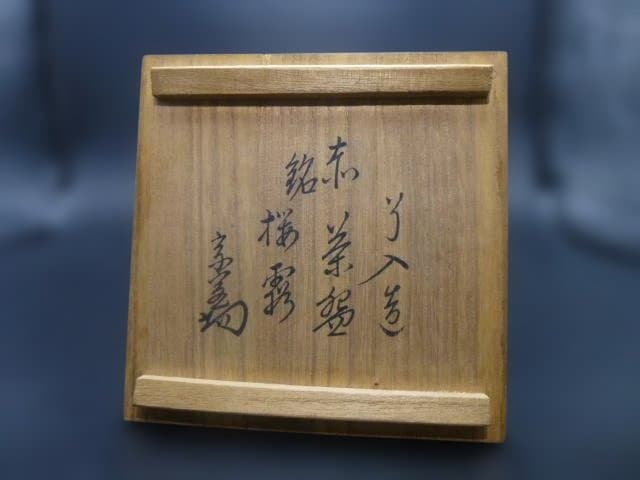
• Box: Tomobako (original paulownia storage box) with kiwame (authentication inscription) by Omotesenke 14th iemoto Jimyōsai Sōsa (表千家十四代 而妙斎)
• Seal: Raku mark impressed beside the foot, clearly legible
• Condition: No chips, no cracks, no restoration. Natural kiln landscapes and quiet surface patina consistent with careful use and centuries of storage.
🔹 [ CULTURAL & ARTISTIC INSIGHT ]
Ryōnyū is remembered as one of the great revivers of the Raku lineage — the ninth head of the family, working in the late Edo period, who reached back toward the quiet gravity of Chōjirō and the sculptural freedom of Kōetsu and brought them forward into a new century. His bowls are not imitations of the past. They are a conversation with it, held in clay.
This chawan carries the mei "Sakura-shimo" — Cherry Frost — a single phrase that tells you how the bowl is meant to be seen. In Japanese tea culture, a mei is not a label. It is a reading. Someone, at some point, held this bowl, watched the way pale pink drifted across grey and cream like frost on early cherry buds, and gave that landscape a name. Once named, the bowl enters a different register: it is no longer only ceramic, it is a small season.
The weight of this particular piece comes from a second hand as well. The tomobako carries a kiwame — an authentication inscription — by Jimyōsai Sōsa, the 14th iemoto of Omotesenke, one of the three great schools of tea descending from Sen no Rikyū. A living iemoto's written endorsement functions, in the Western collector market, as the final proof of authorship. Tomobako plus iemoto kiwame is a double certificate of origin, and it places this bowl at the top register of what a Raku chawan can be.
Early spring, before the petals open, frost settles on the buds and is gone by mid-morning. The bowl holds that hour.
🔹 [ DEEP-DIVE COMMENTARY ]
The Raku lineage begins in the late sixteenth century, when the potter Chōjirō, working under the direction of Sen no Rikyū, produced the first hand-formed tea bowls intended specifically for wabi-style chanoyu. From that point forward, the Raku family has passed its name and its kiln from generation to generation, each head inheriting not a style but a responsibility. Ryōnyū, the ninth generation, inherited that responsibility during a period when Kyoto's ceramic culture was broadening outward, and his work is often described as a return to essentials — thicker walls, a fuller hand, a quieter surface.
Aka-Raku, the red variant, is made from Kyoto's jurakudo clay and finished with a lead-flux glaze, then fired at a temperature low enough that the potter can lift the bowl directly out of the kiln with iron tongs while it is still glowing. This process is intimate and unforgiving. Every bowl records, in its surface, the exact hand that shaped it and the exact moment it left the fire. This is why authorship in Raku ware is not a biographical detail — it is visible in the object itself.
In tea culture, the practice of giving a bowl a mei belongs to a different discipline entirely. A mei is usually bestowed by a tea master or a collector after long observation. It is not decorative. It is a record of recognition. "Sakura-shimo" — Cherry Frost — is a seasonal name of particular refinement: it locates the bowl in a specific hour of a specific week of early spring, when frost and blossom briefly share the same branch. A bowl with such a name is expected to be used in that season, and it is expected to be worthy of the name every time.
The kiwame box by Jimyōsai carries its own cultural weight. Omotesenke is the senior branch of the three Sen schools, and its iemoto speaks with institutional authority within the tea world. When a living iemoto inscribes a bowl, the inscription is not a souvenir. It is a formal act that places the object within the school's recognized canon of utensils. For collectors outside Japan, this is the closest equivalent to a museum certificate — and in the Japanese market, it carries more weight.
Taken together — ninth-generation authorship, Edo-period provenance, a poetic mei, and a contemporary iemoto endorsement — this chawan sits at the intersection of every axis that defines value in Japanese tea ceramics. It is, quite literally, a working object of cultural weight. The only question is who is ready to receive it.
[ JAPANESE DESCRIPTION / 日本語解説 ]
🔹 [ 基本情報 ]
• 作家: 楽 九代 了入 (1756-1834)
• 技法: 赤楽 — 聚楽土を手捏ねで成形し、鉛白釉を用いて約800度で低温焼成
• 時代: 江戸後期(18世紀後半〜19世紀前半)
• 産地: 京都・楽家窯
• 寸法: 幅約11.8cm × 高さ約7.4cm
• 銘: 「桜霜」(Sakura-shimo) — 早春の朝、桜の蕾に降りる薄霜を想起させる詩的な銘
• 箱: 共箱(桐箱)— 表千家十四代 而妙斎宗左による極め書付
• 印: 高台脇に楽印が明瞭に残る
• 状態: 無傷・無ヒビ・無修理。自然な景色と落ち着いた肌合い、丁寧に用いられてきた気配
🔹 [ 文化的・芸術的背景 ]
了入は楽家の中でも「中興の祖」の一人として位置づけられる九代目です。長次郎の静けさと光悦の造形的自由を、江戸後期の京都でもう一度呼び戻した人物であり、その作風は過去の模倣ではなく、過去との対話として現れます。この茶碗が持つ厚みのある造形、落ち着いた赤楽の景色、静謐な高台周りは、まさに了入の手の記憶をとどめています。
銘「桜霜」は、この器に与えられた詩的な読みです。日本の茶道における銘は単なる名前ではなく、器の景色や季節感、時間の一瞬を一語に凝縮する行為です。淡い桜色と灰、温かな黄白が溶け合うこの器の景色を見て、誰かが「早春の朝、桜の蕾に降りる薄霜」を見出し、その情景を一語で封じ込めた — それが「桜霜」という銘です。名を得た瞬間、器はひとつの季節そのものになります。
そしてこの器を最高位へと押し上げているのが、表千家十四代 而妙斎宗左による極め箱です。現役の家元による極め書付は、欧米のコレクター市場においても「真贋の最終証明」として機能し、共箱との二重鑑定は楽茶碗の格を最上位へと引き上げます。
🔹 [ 深掘り解説 ]
楽家は十六世紀末、千利休の指導のもとで長次郎が侘び茶のための手捏ね茶碗を焼き始めたことに始まります。以来、楽家は代々その名と窯を受け継ぎ、それぞれの当主は「様式」ではなく「責務」を継承してきました。九代 了入はその責務を、京都の焼き物文化が外へと広がりつつあった時代に引き受け、厚みのある造形、量感ある手取り、静かな釉肌で「本質への回帰」を示した陶工として知られています。
赤楽は京都・聚楽の土と鉛白釉を用い、低温で焼成されます。器が赤く輝いたまま鉄鋏で窯から取り出されるこの工程は親密で、やり直しがききません。だからこそ一碗一碗に、作り手の手と、火から離れた瞬間がそのまま刻まれます。楽茶碗における「作家性」とは経歴の話ではなく、器そのものに見える事実なのです。
銘の文化は、それとはまた別の規律に属します。銘は通常、茶人や所持者が長い時間をかけて観察した末に与えるものであり、装飾ではなく「認識の記録」です。「桜霜」という銘は特に洗練された季銘のひとつで、早春の特定の一週間、特定の朝の一時間 — 霜と蕾が同じ枝に並ぶ短い時間 — を器の中に封じ込めます。その銘を持つ器は、その季節にこそ用いられるべきであり、名に値し続けることを期待されます。
而妙斎による極め箱もまた、独自の重みを持ちます。表千家は三千家の本家筋にあたり、その家元は茶の湯世界における制度的権威を担います。現役の家元が一碗を極めるという行為は記念品ではなく、その器を学校の正典に正式に位置づける行為です。海外の蒐集家にとっては、これは美術館証明に最も近いものであり、日本国内の市場においてはそれ以上の重みを持ちます。
九代という作家性、江戸期の出自、詩的な銘、そして現代家元の極め — これらが重なるとき、この茶碗は日本の茶陶において「価値」を定義するすべての軸が交差する一点に立ちます。
🔹 [ SHIPPING & PACKAGING ]
• Dispatch: Within 1-6 business days
• Carrier: Japan Post EMS / UPS (with tracking)
• Packaging: Carefully wrapped with protective materials
🔹 [ BASIC DETAILS ]
• Artist: Raku Ryōnyū IX (楽 九代 了入, 1756-1834)
• Technique: Aka-Raku (red Raku), hand-formed (tezukune), low-fired at roughly 800°C with lead-flux glaze
• Era: Late Edo period, late 18th to early 19th century
• Origin: Kyoto, Japan — Raku family kiln
• Dimensions: Approx. 11.8 cm width × 7.4 cm height
• Mei (銘): "Sakura-shimo" (桜霜 / Cherry Frost) — a poetic name evoking a thin frost settling over cherry buds at dawn in early spring
• Box: Tomobako (original paulownia storage box) with kiwame (authentication inscription) by Omotesenke 14th iemoto Jimyōsai Sōsa (表千家十四代 而妙斎)
• Seal: Raku mark impressed beside the foot, clearly legible
• Condition: No chips, no cracks, no restoration. Natural kiln landscapes and quiet surface patina consistent with careful use and centuries of storage.
🔹 [ CULTURAL & ARTISTIC INSIGHT ]
Ryōnyū is remembered as one of the great revivers of the Raku lineage — the ninth head of the family, working in the late Edo period, who reached back toward the quiet gravity of Chōjirō and the sculptural freedom of Kōetsu and brought them forward into a new century. His bowls are not imitations of the past. They are a conversation with it, held in clay.
This chawan carries the mei "Sakura-shimo" — Cherry Frost — a single phrase that tells you how the bowl is meant to be seen. In Japanese tea culture, a mei is not a label. It is a reading. Someone, at some point, held this bowl, watched the way pale pink drifted across grey and cream like frost on early cherry buds, and gave that landscape a name. Once named, the bowl enters a different register: it is no longer only ceramic, it is a small season.
The weight of this particular piece comes from a second hand as well. The tomobako carries a kiwame — an authentication inscription — by Jimyōsai Sōsa, the 14th iemoto of Omotesenke, one of the three great schools of tea descending from Sen no Rikyū. A living iemoto's written endorsement functions, in the Western collector market, as the final proof of authorship. Tomobako plus iemoto kiwame is a double certificate of origin, and it places this bowl at the top register of what a Raku chawan can be.
Early spring, before the petals open, frost settles on the buds and is gone by mid-morning. The bowl holds that hour.
🔹 [ DEEP-DIVE COMMENTARY ]
The Raku lineage begins in the late sixteenth century, when the potter Chōjirō, working under the direction of Sen no Rikyū, produced the first hand-formed tea bowls intended specifically for wabi-style chanoyu. From that point forward, the Raku family has passed its name and its kiln from generation to generation, each head inheriting not a style but a responsibility. Ryōnyū, the ninth generation, inherited that responsibility during a period when Kyoto's ceramic culture was broadening outward, and his work is often described as a return to essentials — thicker walls, a fuller hand, a quieter surface.
Aka-Raku, the red variant, is made from Kyoto's jurakudo clay and finished with a lead-flux glaze, then fired at a temperature low enough that the potter can lift the bowl directly out of the kiln with iron tongs while it is still glowing. This process is intimate and unforgiving. Every bowl records, in its surface, the exact hand that shaped it and the exact moment it left the fire. This is why authorship in Raku ware is not a biographical detail — it is visible in the object itself.
In tea culture, the practice of giving a bowl a mei belongs to a different discipline entirely. A mei is usually bestowed by a tea master or a collector after long observation. It is not decorative. It is a record of recognition. "Sakura-shimo" — Cherry Frost — is a seasonal name of particular refinement: it locates the bowl in a specific hour of a specific week of early spring, when frost and blossom briefly share the same branch. A bowl with such a name is expected to be used in that season, and it is expected to be worthy of the name every time.
The kiwame box by Jimyōsai carries its own cultural weight. Omotesenke is the senior branch of the three Sen schools, and its iemoto speaks with institutional authority within the tea world. When a living iemoto inscribes a bowl, the inscription is not a souvenir. It is a formal act that places the object within the school's recognized canon of utensils. For collectors outside Japan, this is the closest equivalent to a museum certificate — and in the Japanese market, it carries more weight.
Taken together — ninth-generation authorship, Edo-period provenance, a poetic mei, and a contemporary iemoto endorsement — this chawan sits at the intersection of every axis that defines value in Japanese tea ceramics. It is, quite literally, a working object of cultural weight. The only question is who is ready to receive it.
[ JAPANESE DESCRIPTION / 日本語解説 ]
🔹 [ 基本情報 ]
• 作家: 楽 九代 了入 (1756-1834)
• 技法: 赤楽 — 聚楽土を手捏ねで成形し、鉛白釉を用いて約800度で低温焼成
• 時代: 江戸後期(18世紀後半〜19世紀前半)
• 産地: 京都・楽家窯
• 寸法: 幅約11.8cm × 高さ約7.4cm
• 銘: 「桜霜」(Sakura-shimo) — 早春の朝、桜の蕾に降りる薄霜を想起させる詩的な銘
• 箱: 共箱(桐箱)— 表千家十四代 而妙斎宗左による極め書付
• 印: 高台脇に楽印が明瞭に残る
• 状態: 無傷・無ヒビ・無修理。自然な景色と落ち着いた肌合い、丁寧に用いられてきた気配
🔹 [ 文化的・芸術的背景 ]
了入は楽家の中でも「中興の祖」の一人として位置づけられる九代目です。長次郎の静けさと光悦の造形的自由を、江戸後期の京都でもう一度呼び戻した人物であり、その作風は過去の模倣ではなく、過去との対話として現れます。この茶碗が持つ厚みのある造形、落ち着いた赤楽の景色、静謐な高台周りは、まさに了入の手の記憶をとどめています。
銘「桜霜」は、この器に与えられた詩的な読みです。日本の茶道における銘は単なる名前ではなく、器の景色や季節感、時間の一瞬を一語に凝縮する行為です。淡い桜色と灰、温かな黄白が溶け合うこの器の景色を見て、誰かが「早春の朝、桜の蕾に降りる薄霜」を見出し、その情景を一語で封じ込めた — それが「桜霜」という銘です。名を得た瞬間、器はひとつの季節そのものになります。
そしてこの器を最高位へと押し上げているのが、表千家十四代 而妙斎宗左による極め箱です。現役の家元による極め書付は、欧米のコレクター市場においても「真贋の最終証明」として機能し、共箱との二重鑑定は楽茶碗の格を最上位へと引き上げます。
🔹 [ 深掘り解説 ]
楽家は十六世紀末、千利休の指導のもとで長次郎が侘び茶のための手捏ね茶碗を焼き始めたことに始まります。以来、楽家は代々その名と窯を受け継ぎ、それぞれの当主は「様式」ではなく「責務」を継承してきました。九代 了入はその責務を、京都の焼き物文化が外へと広がりつつあった時代に引き受け、厚みのある造形、量感ある手取り、静かな釉肌で「本質への回帰」を示した陶工として知られています。
赤楽は京都・聚楽の土と鉛白釉を用い、低温で焼成されます。器が赤く輝いたまま鉄鋏で窯から取り出されるこの工程は親密で、やり直しがききません。だからこそ一碗一碗に、作り手の手と、火から離れた瞬間がそのまま刻まれます。楽茶碗における「作家性」とは経歴の話ではなく、器そのものに見える事実なのです。
銘の文化は、それとはまた別の規律に属します。銘は通常、茶人や所持者が長い時間をかけて観察した末に与えるものであり、装飾ではなく「認識の記録」です。「桜霜」という銘は特に洗練された季銘のひとつで、早春の特定の一週間、特定の朝の一時間 — 霜と蕾が同じ枝に並ぶ短い時間 — を器の中に封じ込めます。その銘を持つ器は、その季節にこそ用いられるべきであり、名に値し続けることを期待されます。
而妙斎による極め箱もまた、独自の重みを持ちます。表千家は三千家の本家筋にあたり、その家元は茶の湯世界における制度的権威を担います。現役の家元が一碗を極めるという行為は記念品ではなく、その器を学校の正典に正式に位置づける行為です。海外の蒐集家にとっては、これは美術館証明に最も近いものであり、日本国内の市場においてはそれ以上の重みを持ちます。
九代という作家性、江戸期の出自、詩的な銘、そして現代家元の極め — これらが重なるとき、この茶碗は日本の茶陶において「価値」を定義するすべての軸が交差する一点に立ちます。
🔹 [ SHIPPING & PACKAGING ]
• Dispatch: Within 1-6 business days
• Carrier: Japan Post EMS / UPS (with tracking)
• Packaging: Carefully wrapped with protective materials
Quantity
Couldn't load pickup availability
Out of stock
View full details