1
/
of
5
Aka-Raku Hira-Chawan — Wooden Box Inscribed Raku Kichizaemon, Named "Seiun", Kyoto Raku Lineage
Aka-Raku Hira-Chawan — Wooden Box Inscribed Raku Kichizaemon, Named "Seiun", Kyoto Raku Lineage
Regular price
Dhs. 2,426.00 AED
Regular price
Sale price
Dhs. 2,426.00 AED
Taxes included.
Shipping calculated at checkout.
A hira-chawan — the wide, shallow bowl made for summer tea — hand-built in raku earthenware and glazed in aka, the red register of the Raku kilns. The colour moves from persimmon at the rim into a smoked olive that settles across the well, the way heat settles unevenly on a body drawn straight from the fire. The walls carry the pressure of the hand rather than the turn of the wheel: pared planes beneath the glaze, a rim that rises and falls a few millimetres around its circuit, a low foot cut short and close to the body. Fine crazing runs the entire interior. Kyoto work, in the Raku lineage.
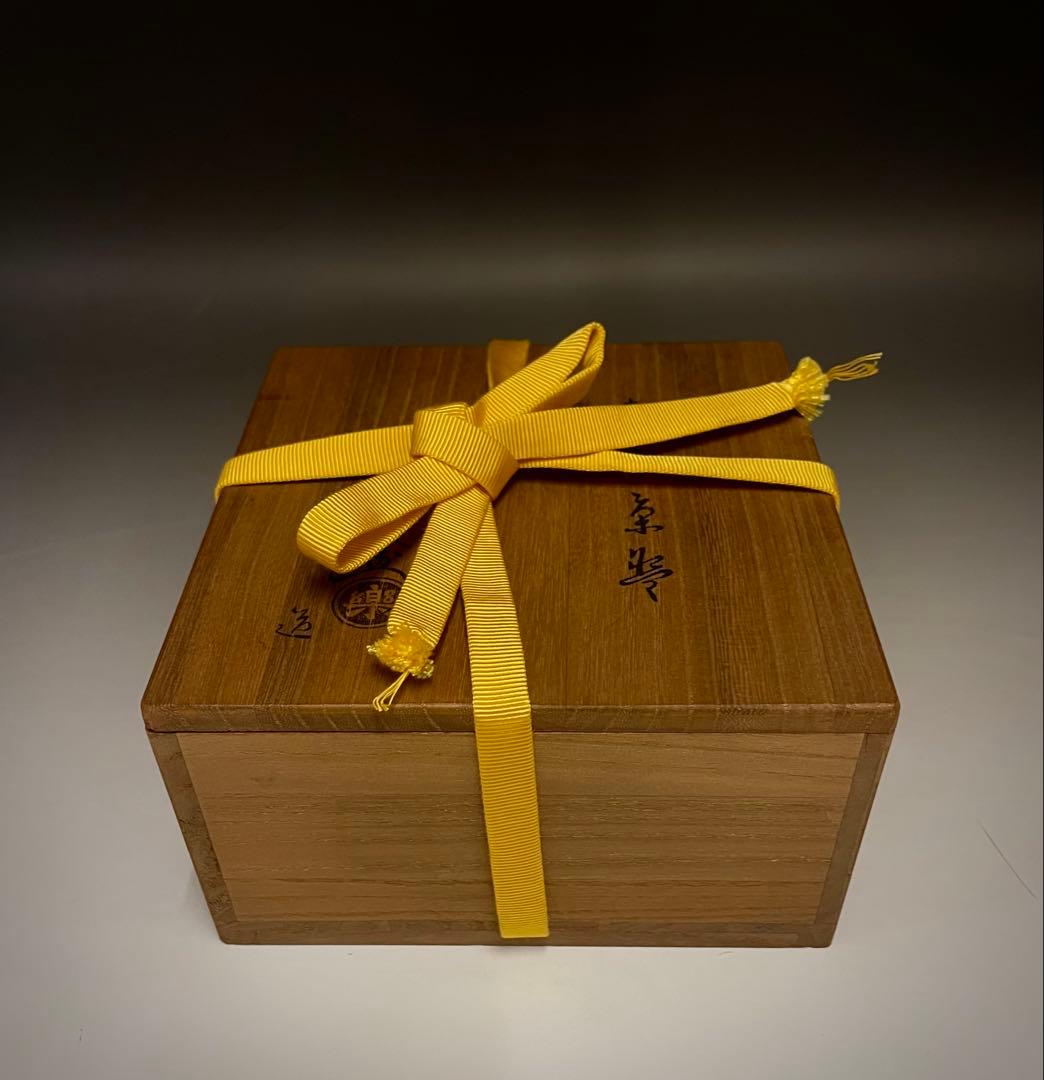
The accompanying wooden box is inscribed 「赤平茶碗」 (aka hira-chawan) across the face, with 「樂吉左衛門造」 and a round impressed 樂 seal to the left. A 樂 stamp is also present beside the foot of the bowl. Inside the lid is a separate inscription reading 「清雲」 — Seiun, "clear cloud" — accompanied by a kaō cipher, which the seller attributes to Sōsai, the twelfth-generation head of Omotesenke. The seller identifies the hand as Raku Kōnyū, the twelfth-generation Raku Kichizaemon. Raku Kōnyū (1857–1932) is a documented historical figure and head of the Raku house in Kyoto; whether this particular bowl came from his hand is a separate question, and one the inscriptions alone do not settle. No certificate accompanies the piece. Independent authentication has not been performed. Attribution rests on the box inscriptions and the seller's description.
🔹 [ BASIC DETAILS ]
• Artist — Not independently verified. The box is inscribed 樂吉左衛門造 with an impressed 樂 seal; the seller identifies the hand as Raku Kōnyū, twelfth-generation Raku Kichizaemon.
• Technique — Hand-built (tezukune) and kanna-pared earthenware; aka (red) raku glaze, low-temperature firing, withdrawn hot from the kiln
• Era — Likely early 20th century, based on glaze surface, foot finish, and the window implied by the lid inscription. Not independently authenticated.
• Origin — Kyoto, Japan — Raku tradition
• Dimensions — Diameter approx. 14.5 cm, Height approx. 5 cm
• Box — Wooden box inscribed and sealed on the face; the lid interior separately inscribed 「清雲」 with a kaō, seller-attributed to Omotesenke 12th, Sōsai. Bound with a yellow silk cord.
• Condition — Good antique condition. Crazing throughout the glaze, characteristic of raku ware. Tonal variation and light surface wear consistent with use. No repair or kintsugi is visible in the photographs.
🔹 [ CULTURAL & ARTISTIC INSIGHT ]
Raku ware begins in the late sixteenth century, in a Kyoto workshop where a tile-maker named Chōjirō worked under the eye of Sen no Rikyū. What they made together was a deliberate refusal: no wheel, no ornament, no imported Chinese refinement. The bowl was shaped by hand, pared with a blade, glazed simply, and pulled from a small kiln while still glowing. It was the first ceramic form in Japan designed from the inside outward — around the temperature of the tea, the width of two palms, the pace of a single guest.
The hira-chawan, the flattened summer bowl, is a seasonal answer within that grammar. Its width lets the tea cool quickly, and its shallow well shows the whole surface of the whisked matcha at once. Aka-raku — the red register — is the warmer of the two classical Raku colours, worked over an iron-bearing clay and fired low, so the body's own tone carries up through the glaze rather than hiding beneath it.
This bowl sits within that tradition. The surface shows the seams of hand-building where the glaze thins over a ridge, a foot cut short and close, and a field of crazing that has taken on colour with age. The olive clouding through the well is the record of where flame and reduction touched unevenly — not a decorative decision, but the firing writing itself down.
Red clay under a clouded glaze — the colour of a summer evening that has not yet decided to cool.
🔹 [ DEEP-DIVE COMMENTARY ]
Raku is defined less by a place than by a method. The clay is a soft, open, sand-tempered body that tolerates thermal shock. Forms are built by hand and then pared with a kanna blade, which is why no two bowls share a profile. Firing happens fast and low — roughly 750 to 1,000°C — and the piece is drawn from the kiln while incandescent. The speed is the point: the glaze freezes before it can level, and the surface keeps a record of motion.
Aka-raku takes its warmth from the clay beneath. A lead-fluxed, largely transparent glaze is laid over an iron-bearing body; in the firing the iron blooms through, and the finished colour ranges across persimmon, ochre, dull rose, and — where the atmosphere reduced unevenly — smoke and olive. Where the glaze runs thin over a pared edge, the raw body shows as a lighter line. Collectors read those lines the way one reads brushwork.
The hira-chawan exists for the hot months. Its proportions are practical before they are aesthetic: more surface, faster cooling, a shallow well that presents the tea's whole face to the guest. In modern practice it appears from roughly May through August, and a shallow bowl handled well is a quiet demonstration of a host's attention to season.
A word on boxes, since they carry so much of the market's weight. A Japanese wooden box is an attribution document, not a certificate. An inscription may be written by the maker, by a later head of a tea school, by a family member, or by a dealer; a box may also be joined to a piece long after the fact. A second inscription on the lid interior — as here, naming the bowl 「清雲」 with a kaō — is a naming act, which in tea culture confers standing and history, but that is a separate matter from establishing the hand that formed the clay. Both are facts worth having. Neither, on its own, is proof.
The Raku house continues in Kyoto to this day, now in its sixteenth generation, and the method has outgrown its origin: potters from Britain to the American Southwest have adopted the withdrawal-from-fire technique. What has not travelled as easily is the restraint — the willingness to leave a bowl exactly as unremarkable as it wants to be.
🔹 [ 日本語解説 ]
夏の茶席に用いられる平茶碗です。手捏ねによる楽焼で、赤楽の釉が口縁の柿色から見込みの燻んだ緑褐色へと移ろいます。ろくろではなく手の圧が形を決めており、篦(かんな)で削がれた面、数ミリの起伏をもつ口縁、低く短く切られた高台がそのまま残ります。見込み全面に細かな貫入が走ります。京都・楽焼の系譜にある一碗です。
付属の木箱には、表に「赤平茶碗」、左に「樂吉左衛門造」と丸印の樂印が記されています。碗の高台脇にも樂印が捺されています。蓋裏には別筆で「清雲」の銘と花押があり、出品者はこれを表千家十二代・惺斎によるものとしています。作者については、出品者は十二代樂吉左衛門・弘入としています。樂弘入(1857–1932)が楽家の当主として実在した人物であることは歴史的事実ですが、この一碗が弘入の手によるものかどうかは別の問題であり、箱書きのみで定まるものではありません。鑑定書は付属しません。独立した鑑定は行っておらず、帰属は箱書きと入手時の情報に基づいています。
【文化と作行き】
楽焼は十六世紀末の京都、瓦師・長次郎が千利休の眼のもとで始めた仕事に発します。ろくろを使わず、装飾を排し、唐物の洗練から意識的に離れる。手で成形し、篦で削り、簡素に釉をかけ、小さな窯から赤熱のまま引き出す。茶の温度、両掌の幅、一人の客の呼吸から逆算して作られた、日本で最初の器の形でした。
平茶碗はその文法のなかの、季節への答えです。広い口径は茶を早く冷まし、浅い見込みは点てられた抹茶の面を一度に見せます。赤楽は二つの古典的な楽の色のうち温かい方で、鉄分を含む土に低火度で釉をかけるため、土そのものの色が釉を透かして立ち上がります。
この一碗はその系譜のなかにあります。稜の上で釉が薄く引ける手捏ねの継ぎ目、短く切り詰められた高台、時を経て色を含んだ貫入の景色。見込みを流れる緑褐の曇りは、炎と還元が均一でなかったことの記録であり、意匠というより焼成そのものの筆跡です。
【技法と鑑賞】
楽焼は産地ではなく方法によって定義されます。砂を含む柔らかい土は急激な温度変化に耐え、手捏ねと篦削りによるため同じ形が二つとありません。焼成はおよそ750〜1000℃と低く、そして速く、赤熱のまま窯から引き出されます。釉が流れ切る前に固まるため、表面には動きがそのまま残ります。
赤楽の温もりは、釉ではなく下の土から来ています。鉄分を含む土に鉛系の透明釉を薄くかけると、焼成のなかで鉄が滲み上がり、柿色・黄土・鈍い薔薇色、そして雰囲気が不均一に還元した箇所には煙色や緑褐が現れます。削り出した稜の上で釉が引ければ、素地が明るい線となって覗きます。その線を、人は筆跡のように読みます。
平茶碗は暑い季節のための器です。その寸法は美意識に先立って実用的で、面が広く、冷めが早く、浅い見込みは茶の全景を客に示します。現代の稽古ではおおむね五月から八月に用いられ、浅い碗を丁寧に扱うことは、亭主の季節への心配りを静かに示す所作でもあります。
箱についてひとこと申し添えます。日本の木箱は「帰属を示す文書」であって、鑑定書ではありません。箱書きは作者本人の場合もあれば、後代の家元、家族、あるいは商人の手による場合もあり、器と箱が後年になって結び付けられることもあります。蓋裏の「清雲」という銘は、茶の文化において器に格と履歴を与える行為ですが、土を成形した手を特定することとは別の事柄です。どちらも意味のある事実であり、どちらも単独では証明にはなりません。
楽家は今日も京都に続き、当代で十六代を数えます。火から引き出す手法は英国からアメリカ南西部にまで広がりましたが、容易に伝わらなかったのは、器をあるがままの姿に留めておく抑制の方でした。
🔹 [ SHIPPING & PACKAGING ]
• Dispatch: Within 1-6 business days
• Carrier: Japan Post EMS / UPS / FedEx (with tracking)
• Packaging: Carefully wrapped with protective materials
Quantity
Couldn't load pickup availability
Out of stock
View full details